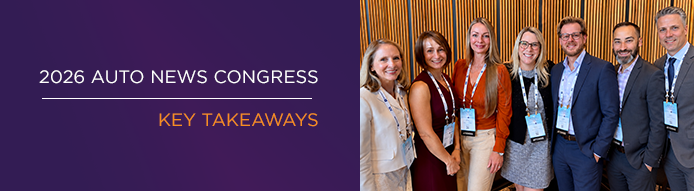
Automotive Retail Software, AI, and Affordability: Key Takeaways from Automotive News Congress
As if we needed more confirmation, the 50th Automotive News Congress reinforced that the automotive industry is navigating a period of significant change.
Three topics hogged the mic:
- Affordability and consumer demand
- The growing influence of AI
- Increasing competition from Chinese automakers
Automotive retail software, predictive analytics, and AI can all play a role in helping brands, dealer groups, and retailers find growth while navigating a challenging market.

The Automotive Industry Is Facing Pressure from Every Direction
Competition is intensifying. Consumers are doing countless hours of research before stepping into a showroom. And affordability continues to influence nearly every purchase decision.
At the 2026 Automotive News Congress, leaders from across the industry gathered to discuss what’s changing and what comes next. The brands that understand their customers best and act on those insights fastest will be in the strongest position going forward.
Key Takeaways for OEMs
- Automotive retail software is becoming a competitive advantage, not just an operational tool.
- Predictive analytics can help OEMs and dealers better understand customer demand.
- AI is changing how consumers research and shop for vehicles.
- Affordability is shaping everything from product strategy to customer engagement.
- Service-drive customers remain one of the most underutilized growth opportunities in automotive retail.
Competition Is Raising the Bar Across the Industry
Chinese automakers have integrated Western automotive technology and process management with advanced battery development capabilities. This combination of technology, scale, and supply-chain advantages has accelerated Chinese automakers’ ability to compete globally. Many industry leaders don’t believe the answer is simply playing defense, though.
“Rather than viewing that progress solely through a defensive lens, it should challenge all of us in the U.S. automotive ecosystem to become faster, more innovative, and more forward-thinking.”
For OEMs, that means looking beyond product development alone. Success increasingly depends on supporting dealers, improving customer retention, and identifying opportunities before consumers begin shopping elsewhere.
This is where automotive retail software and predictive analytics can help. Better customer insights make it easier to engage buyers at the right time, personalize outreach, and strengthen both acquisition and retention efforts. In many ways, tomorrow’s competitive edge may come as much from customer insights as it does from vehicle innovation.
Why Understanding Customer Behavior Matters More Than Ever
For years now, vehicle shoppers have not followed a straight path to purchase. They compare cars online, explore financing options, visit multiple websites, and often spend months researching before making a decision. Many are also delaying purchases because of affordability concerns.
That makes visibility into customer behavior more important than ever.
By using predictive analytics for dealerships, OEMs can gain a better understanding of purchase intent, ownership trends, retention risks, and opportunities throughout the ownership journey. The more OEMs understand how customers behave, the better they can support dealers and create more consistent experiences across the retail network.
AI Is Changing How Consumers Shop for Vehicles
Consumers are already using AI-powered tools to research vehicles, compare options, and get answers to questions they used to type into search engines. That shift is changing how brands think about visibility online.
“OEMs, captives, and dealers must start thinking beyond traditional SEO. Consumers increasingly expect direct answers from AI-powered tools, which means data quality, connected systems, and Answer Engine Optimization will become critical components of customer engagement.”
The formula for visibility in AI-generated answers is accurate data, connected systems, and information consumers can trust.
AI is also influencing much more than search. It’s impacting the following:
- Automotive digital retailing
- BDC operations
- Customer communications
- Lead prioritization
- Marketing personalization
- Customer lifecycle marketing
As more consumers begin their shopping journey through AI-powered experiences, brands that invest in stronger data foundations will have an advantage.
OEMs, captives, and dealers looking to prepare for that future should continue exploring automotive digital retailing strategies and AI-enabled sales tools that improve the customer experience.
Affordability Continues to Shape Automotive Strategy
Affordability was one of the most consistent themes throughout the event. Vehicle prices remain elevated. Financing costs are still impacting purchasing decisions. Many consumers are holding onto vehicles longer than they have historically.
“Automakers are all having to do more with less as budgets tighten. The conversation around affordability ultimately comes back to helping consumers find vehicles that fit their financial reality while helping retailers focus resources where they will have the greatest impact.”
Automakers are trying to solve a difficult challenge: advancing electrification while still offering vehicles consumers can realistically afford. That’s one reason hybrids and more affordable vehicle options continue to play an important role in many product portfolios.
The ability to balance vehicle affordability while improving dealer network performance has become a major focus across the industry.
Better Data Can Help Solve Affordability Challenges
When budgets are tight, efficiency matters. Broad marketing campaigns and generic outreach become harder to justify when every dollar needs to work harder.
Instead, many OEMs and dealers are looking for ways to focus on the customers most likely to act. Using automotive retail intelligence, dealerships can identify customers who may be able to upgrade into a newer vehicle while maintaining a similar monthly payment.
They can also improve customer acquisition by focusing on higher-probability opportunities rather than casting the widest possible net. Rather than relying on assumptions, teams can prioritize outreach based on predictive purchase intent and customer behavior.
For OEMs, that means more efficient marketing, stronger dealer performance, and better alignment between inventory and actual demand.
Don’t Overlook the Service Drive
One of the biggest opportunities in automotive retail is already sitting in the service lane. Some customers are perfectly happy with their current vehicle. Others may be approaching a lease end, thinking about an upgrade, or feeling the effects of rising ownership costs.
By implementing a strong service-to-sales strategy, dealers can identify those opportunities earlier and create more meaningful conversations.
Tools like Recall Connect can also help dealerships proactively reach customers with open safety recalls, which, in turn, provides a better customer experience and creates additional touchpoints.
When paired with customer insights and predictive analytics, the service department becomes more than a maintenance destination. It becomes an important contributor to customer retention and long-term growth.
Dealers looking to improve retention and uncover new sales opportunities can also benefit from customer lifecycle marketing strategies that identify ownership milestones and purchase signals earlier in the journey.
Especially in a tighter market, existing customers often represent the most efficient path to growth.
Looking Ahead
Competition is increasing. Consumers are changing how they shop, AI is reshaping how people search for information, and affordability continues to strongly influence buying behavior.
The companies that succeed won’t necessarily be the ones spending the most money. They’ll be the ones making smarter decisions with the data they already have.
“After spending time with leaders from Ford, GM, Mercedes-Benz, Hyundai and across the broader ecosystem, I left Detroit thinking less about any single technology or competitor and more about the need for our industry to keep learning, adapting, and moving forward.”
For OEMs and dealers alike, the path forward isn’t about chasing every new trend. It’s about understanding customers, supporting retailers, and using data intelligently to build stronger relationships throughout the ownership journey.
Explore Automotive Retail Intelligence Solutions
Want to learn more?
Visit automotiveMastermind.com for additional insights on predictive analytics, automotive retail software, customer retention, AI, and dealership performance. The better you understand your customers, the better positioned you’ll be to navigate whatever comes next.
Frequently Asked Questions
Automotive retail software helps OEMs and dealerships identify opportunities, improve customer acquisition and retention, and make better decisions using predictive analytics and customer insights.
Predictive analytics helps dealerships identify customers who may be ready to purchase, lease, trade, or service a vehicle, allowing teams to focus on the opportunities most likely to result in action.
OEMs can improve dealer network performance by equipping retailers with better customer insights, predictive analytics, retention strategies, and tools that help prioritize high-value opportunities.
AI-enabled sales tools help dealerships prioritize leads, personalize communications, streamline workflows, and identify customers most likely to engage.
Automotive digital retailing refers to the tools and processes that allow consumers to research, compare, finance, and purchase vehicles through connected digital experiences.
Customer data helps OEMs better understand ownership trends, improve retention, support dealers, and create more relevant experiences throughout the customer journey.