Beyond the Open Rate: Why Modern Dealership Email Marketing Requires a One-to-One Strategy


Author: Caroline Student, Sr. Director of Predictive Marketing, automotiveMastermind
This article is the first installment in our three-part series, The New Email Marketing Playbook for Car Dealers. As the inbox landscape evolves, we explore how dealership marketers must adapt to reach high-intent customers, measure success, and drive sales.
Over the past year, three major shifts have fundamentally transformed email marketing not just for automotive dealers, but for all businesses that use email as a marketing lever:
- Evolving tracking pixel behavior, which has made traditional open rate reporting increasingly unreliable across major providers like Gmail
- Gemini AI-powered inbox experiences, which allow recipients to view AI-generated email summaries directly within their inbox feed without opening the message itself
- Heightened sender reputation and delivery guidelines, placing far greater emphasis on database quality, low-funnel relevance, and direct recipient engagement
Together, these changes mark the end of the “email blast” era. Email is no longer a broad, high-funnel channel designed for mass broadcasting. Email is now a critical, low-funnel tool built for targeted, one-to-one customer communication.
In this first installment, we focus on one of the most visible changes in dealership marketing dashboards: why open rates are no longer the benchmark they once were and how dealers can strengthen their email strategy.
Key Takeaways for Dealers
| Action | Why It Works |
| Ditch Vanity Metrics | Stop measuring success by unreliable tracking pixels; focus on clicks, direct replies, and down-funnel sales conversions. |
| Pivot to 1-to-1 Low-Funnel Messaging | Use personalized, data-driven offers that reach customers when they exhibit purchase signals. |
Why Email Open Rates are Becoming Even Less Reliable
How Email Opens are Measured
In early 2026, email marketers began noticing a sudden decline in reported Gmail opens. Yet, because other email engagement metrics held steady in many cases, deliverability experts believe this drop was driven at least in part by changes in how opens are measured, rather than a real shift in subscriber engagement.
While Google has not publicly confirmed any changes to Gmail’s tracking behavior, a leading theory among experts is that Gmail may be reducing certain forms of automated image prefetching that historically triggered open events. As a result, fewer opens are being recorded even when actual readership may be unchanged.
For dealerships, this distinction matters. Because Gmail addresses often make up a significant portion of a CRM database, even subtle changes in how Gmail handles email activity can have an outsized impact on reported campaign performance.
The Tracking Pixel Shift
Let’s take a look at how email open tracking works. Email providers track opens using a tiny, invisible 1×1 image called a tracking pixel. However, pixels can be triggered by more than just human readers, including privacy tools, spam filters, caching systems, and automated image prefetching. For that reason, open rates have always been an estimate of engagement rather than a precise measure of readership. And, according to recent email infrastructure studies, automated background preloading has skewed email data for years.
If Gmail has indeed reduced some of that automated image activity, fewer tracking pixels would fire, and reported open rates would naturally decline. This drop does not mean buyers are losing interest; it just means the way we measure opens has changed. Ultimately, open rates measure a mix of system behavior and human engagement, making them an unreliable primary KPI.
The Metrics Smart Dealerships Measure Instead
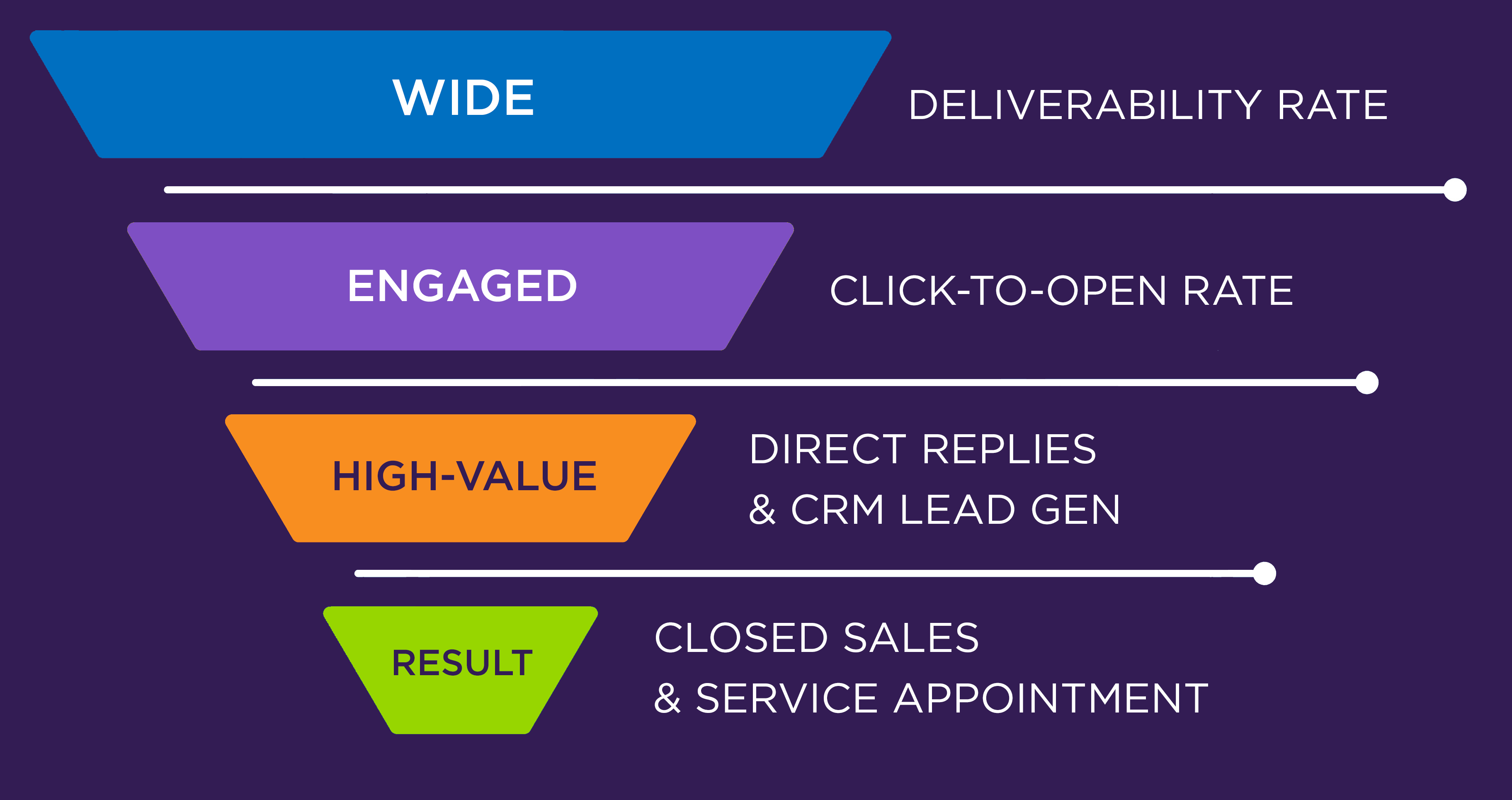
To evaluate performance accurately, dealerships should shift focus away from vanity metrics and prioritize high-intent engagement indicators:
- Click-Through Rate (CTR): Measures active engagements from customers clicking on inventory, trade-in valuations, service offers, or other dealership content
- Click-to-Open Rate (CTOR): The ratio of clicks relative to opens, which signals content resonance (this should be used as a directional insight, not a standalone KPI, as it relies on open-rate data)
- Direct Email Replies: One of the strongest intent signals possible, which directly improves your sender reputation with inbox providers
- Business Conversion Outcomes: Test drives, scheduled service appointments, valuation requests, and sold units
In short, if a campaign generates fewer opens but produces more showroom traffic and more sold vehicles, it’s working.
The takeaway is clear: success is not defined by whether an email is opened, but by whether it drives meaningful customer engagement and business outcomes. Yet evolving open-rate measurement is only one of the major changes affecting dealership email marketing. AI-powered inbox experiences are also changing how customers interact with email before they ever open a message.
AI Doesn’t Devalue Email Marketing. It Rewards Better Email Marketing.
New AI-powered inbox experiences, including Gmail’s Gemini capabilities, increasingly summarize messages before recipients open them. That means dealers must optimize email content not just for the customer, but also for the AI systems helping customers process information. That shift creates a new competitive advantage for dealerships that prioritize personalized messaging.
What’s Next in This Car Dealership Email Marketing Series?
Part 2: Navigating the AI Inbox: How Gemini AI is Shifting Dealership Email Strategy
Part 3: Quality Over Quantity: Sender Reputation, List Hygiene, and Maximizing Dealership Email Engagement
The rules of email marketing are changing. Dealerships that understand all three shifts will be better equipped to maximize engagement, protect deliverability, and drive measurable business results.
Sources
https://www.beehiiv.com/support/article/38340775067415-declining-open-rates-a-diagnostic-guide
https://www.mailgun.com/blog/deliverability/gmail-open-rates-suddenly-dropping/
https://www.validity.com/blog/whats-really-behind-gmails-open-rate-drop-and-what-to-do-about-it/
Ready to Navigate the New Era of Email Marketing?
For existing customers, reach out to your Dealer Relations Manager to see how automotiveMastermind helps dealers adapt to this new email marketing reality.
FAQs
Email open rates are not reliable for dealerships as a standalone measure of success. Open rates have always been based on tracking pixel activity rather than confirmed human engagement. Recent changes observed across Gmail, combined with AI-powered inbox experiences and evolving privacy features, have made open rates even less reliable as a primary KPI. While they can still provide directional insight, dealerships should avoid using open rates as their primary measure of campaign performance.
Dealerships should focus on metrics that reflect genuine customer interest and business outcomes, including click-through rates, trade-in valuation requests, service appointment bookings, direct customer replies, lead generation, and vehicle sales. These actions provide a clearer picture of customer intent and marketing effectiveness than open rates alone.
A decline in open rates alone does not necessarily indicate worsening deliverability. If clicks, conversions, and other engagement metrics remain healthy, the issue is likely related more to measurement than inbox placement.
automotiveMastermind offers a platform designed to help dealers identify potential opportunities within the service drive, such as customers who are already visiting the dealership’s service bays and exhibit signals associated with trade-in or purchase consideration.